

11 Oct Personal Safety in South Africa
We would all like to believe that we are invincible, that nothing “bad” will ever happen to us or our loved ones. That we will always be safe and that no harm will ever come to us. For example, we have walked the same route for the past however many years and have always been safe without being bothered by crime or criminal elements – so why would that change? Unfortunately, criminals continue to become more and more brazen in their efforts to commit crimes and will stop at nothing to get what they want.
But what can we do to ensure our personal safety?
There are numerous tips or strategies to assist a person in trying to keep themselves safe as they navigate their surroundings on a daily basis. Some seem a bit like common sense in terms of safety guidelines but let’s be honest, at times common sense does tend to fly out of the window when we aren’t concentrating, out with friends or even just intent on getting somewhere in a hurry!
1. Stay Alert
Sounds quite easy doesn’t it? A simple rule to put into practice: Keep an eye on your surroundings, notice anything or anybody that looks suspicious or gets that sixth sense screaming in your head. Then act on it!
This includes scenarios such as noticing people who may be following you, an individual who is standing just a l-i-t-t-l-e bit too close at the ATM while you are busy drawing money or even a suspicious vehicle in your area that keeps driving the same route very slowly or deliberately.
2. Keep your keys accessible
Whether you are heading towards your car or getting ready to unlock your home, keep your keys in your hand, where they are easily accessible to use.
The couple of seconds where you would be searching for your keys or readying yourself to unlock your front door, could be the difference between becoming a victim of crime, or being safe.
Having your vehicle’s keys or remote easily available allows you to quickly get into the car safely, without someone being able to grab your bag, shopping or even hijack you. Remember that once you are safely in the car, you need to ensure that all the doors are locked to stop someone gaining access to you and your belongings.
3. Ensure that your car is indeed locked
Criminals are very clever, with one of the schemes they use to gain access to your vehicle being remote blocking or jamming. This prevents your car from locking, even though you have used your remote to diligently lock your car…and you are under the impression that it is safely locked! Always check that it is actually locked by trying the door, prior to walking away.
4. Don’t leave venues alone
When leaving a club, shopping centre, restaurant or even the gym, remember that old saying: “There is strength in numbers.”
Don’t leave alone. Walk with a friend or two as you are far less of a target that way. It is easy for criminal elements to take advantage of a single person, but those walking in a group are far more likely to be left alone as criminals search for soft targets, such as people walking alone or the young and elderly.

5. Stay out of the shadows
Try to keep to well-lit areas, where you – or somebody up to no good – can easily be seen or spotted. Stay away from shadows, gloomy or dimly lit areas if at all possible. Not only are you not easily visible, but it provides the perfect hideout for those individuals not wanting to be noticed and cause trouble.
6. Fake it ‘til you make it!
It’s all in the attitude as they say! Walk with confidence, your head held high and with a purpose! If you act nervous or scared, there is more of a chance that you will be seen as an easy target who might not put up a fight should you be confronted.
Also be sure to make casual eye contact as you walk, to display confidence in both yourself and the situation.
7. Carry some personal protection or an alarm
No, we are not referring to a gun or knife, these may well be used against you. Rather look at carrying something such as mace. Even a whistle that will attract attention when being blown could do the trick by highlighting the situation and drawing attention to you, hopefully resulting in you being released or no longer targeted.
8. Trust that gut!
If something doesn’t feel right, go with your gut and act on it. Don’t draw money at the ATM, find another one. Speak to a security guard if you feel that someone is following you in a shopping centre. Get security to walk you to your car if you have been shopping late at night and feel unsafe. Rather safe than sorry!
9. Keep away from strangers
Strangers are not always friends that we have not yet met…sometimes they can be out to rob you or pickpocket you or worse! Stay away from strangers and, no matter your age, don’t talk to strangers!
10. Leave items of value at home
Thieves are everywhere, looking at any opportunity to strike. Remember this when out and avoid showcasing valuables, such as expensive watches, cell phones or jewellery where they can easily be seen and targeted.
Keep away from very crowded streets or areas as these are perfect pickings for pick pockets, who blend into crowds after nabbing your valuables.

11. Enable Yourself – Safety First
Enable yourself with a good self-defence course. There are numerous reasons why a self-defence course would be a good idea, including an increase in self-esteem, improved physical fitness, teaching awareness of your surroundings as well as helping people deal with trauma, should they have been a victim in the past.
Self-dense classes also assist in teaching people how to defend themselves against assault and sexual assault. Be prepared!
12. Know Your Emergency Numbers
Should you require assistance, it is always good to know which emergency numbers to call. This includes the South African Police Service (SAPS) on 10111 or your own emergency contact, whether it be your husband, wife or friend.
It may well be a good idea to memorise these, since you may require them in an emergency where you might not have access to your cell phone.
13. Ask for Help
Last but not least, ask for assistance should you need it. Approach the nearest police officer or security guard to assist you. Don’t be shy or feel that you are a burden, trust your gut and get help to deal with the situation.
What to when you are a victim of crime
• First and foremost, go and get help immediately;
• Contact Emergency Services for assistance. They can be reached on:
o Emergency – Ambulance (10177)
o Emergency – Via Cell phone (112)
o Emergency – National (10111)
• Make as much noise are you are able to and as soon as you can, move to somewhere safe;
• If you have been sexually assaulted, do not shower or change as you will need to be examined and your clothes taken in as evidence. Showering or bathing will destroy any possible evidence;
• Should your house keys have been taken or stolen, change the locks to your home;
• Phone a friend or family member to support you and be with you should you be nervous or scared;
• Depending on the crime or situation, consider going for trauma counselling to process what has happened to you.
Reporting Crimes or Offenders
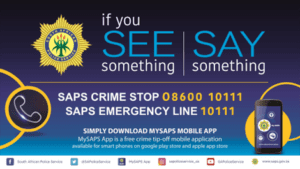
In South Africa, the SAPS has a share-call line that people may use voluntarily, to share details or pass on information of a crime that has been committed, is being planned or even information pertaining to those who have committed crimes in the past.
You do not have leave your name or contact details, information may be given anonymously and any assistance in tracking down perpetrators would be greatly appreciated. Not only are you assisting in taking criminals off the streets and solving crimes, but you are making South Africa a safer place for all who live here.
Should you wish to report a crime or leave an anonymous tip, call Crime Stop on 08600 10111.
Your safety is your responsibility. Take action today to stay safe in an ever-changing environment by applying these tips and techniques for your personal safety.
